Case studiesReference integration: event history and work order record
Business events into Postgres as the operational record
How OpexFlow turns work order and alarm events from JetStream into rows people can query in Postgres: one row per event, one row per work order, safe against a resend, a redelivery and an arrival in the wrong order.
Why keep the events in a table
JetStream is the log: ordered, durable, replayable. It is not where a planner asks which work orders are open on machine cnc-02, or where an auditor asks who produced the event behind a ticket. Those questions belong to SQL. The job of the flow is to write what the bus carries into tables that answer them, without ever writing the same fact twice.
Three tables
bus_events keeps every accepted event whole, with its envelope fields and its payload as jsonb. It is the history and the audit trail. work_orders holds the current state of each order, assembled from the ERP release, the MES creation and the answers of OpexMX and the ERP. alarms holds the alarms and the maintenance ticket each one opened.
CREATE TABLE bus_events (
  event_id       uuid PRIMARY KEY,
  schema_id      text        NOT NULL,
  nats_subject   text        NOT NULL,
  producer       text        NOT NULL,
  correlation_id text,
  occurred_at    timestamptz NOT NULL,
  received_at    timestamptz NOT NULL DEFAULT now(),
  payload        jsonb       NOT NULL
);
The flows write with the sql node. Every value is a bound parameter, never text in the statement. The statements are upserts, so running one a second time changes nothing.
INSERT INTO work_orders (work_order_id, machine_id, erp_ref, wo_type, title, priority, status, released_at)
VALUES (${metadata.value.payload.workOrderId}, ${metadata.value.payload.machineId}, ${metadata.value.payload.erpRef?},
        ${metadata.value.payload.type?}, ${metadata.value.payload.title?}, ${metadata.value.payload.priority?}, 'released',
        ${metadata.value.payload.releasedAt})
ON CONFLICT (work_order_id) DO UPDATE SET
  erp_ref = COALESCE(EXCLUDED.erp_ref, work_orders.erp_ref),
  released_at = EXCLUDED.released_at,
  machine_id = COALESCE(work_orders.machine_id, EXCLUDED.machine_id),
  updated_at = now()
Three layers against a repeat
A message can come twice for three different reasons, and each has its own guard.
| Cause | Guard | Where it acts |
|---|---|---|
| The producer resends and sets the same Nats-Msg-Id | JetStream duplicate window (24 hours for OPEX_EVENTS) | Before OpexFlow sees the message |
| The producer resends without the header, or after the window | The dedupe node on the eventId, for 30 days | In the flow, before any write or call |
| OpexFlow redelivers after a failure further down | The primary key of bus_events and the upserts | In Postgres |
The dedupe node remembers a key only after the whole path has finished, so a message that failed halfway passes it again on redelivery and is made safe by the third guard. This is the difference between at-least-once delivery and a result that is correct when read.
Tested cases
| Case | What happened | Result |
|---|---|---|
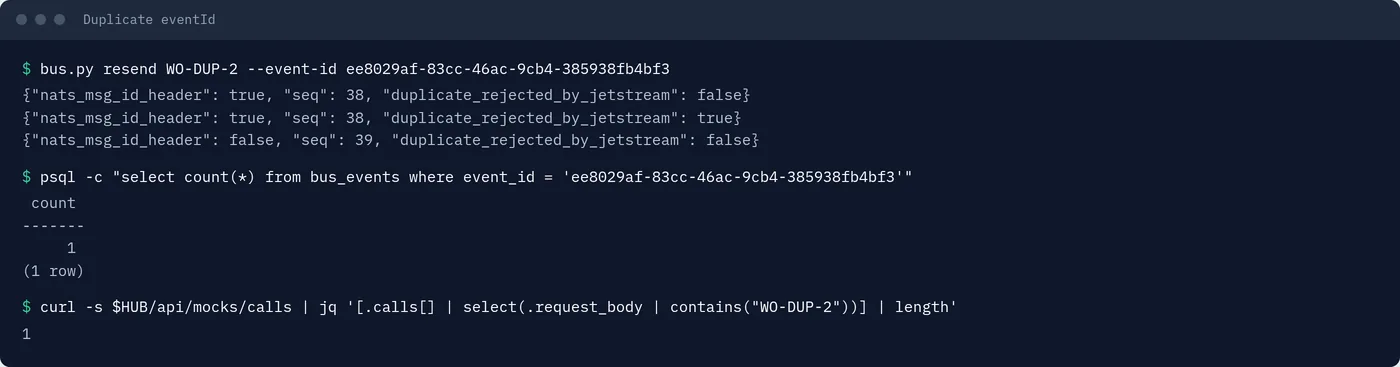
| Resent with and without the header | The same created event three times: with Nats-Msg-Id twice, then without it | The second was rejected by JetStream (duplicate: true), the third reached the flow and the dedupe node dropped it. One row in bus_events, one call to OpexMX |
| OpexMX answers 503 | Three created events, each attempted four times while the call was refused | bus_events held one row per event the whole time. The work order rows existed without a ticket until OpexMX returned, then all three had one |
| Created before released | MES created the order, the ERP release arrived six seconds later | One work order row with both timestamps, the ERP reference and the acknowledgement. The release did not reset the status |
| Contract violation | A created event with a wrong type and no createdAt | Nothing written; parked in Dead letters at the payload check |
| An alarm | alarm.raised.v1 for machine cnc-02 | One row in alarms with the OpexMX ticket MXT-AL-2001 |
The released flow does the second half of the ERP hand-over. When the release arrives after the order was created, it finds the order in Postgres with an OpexMX ticket and sends the status to the ERP itself. When it arrives before, the created flow does it. Either order ends with one acknowledged work order.


What the tables answer
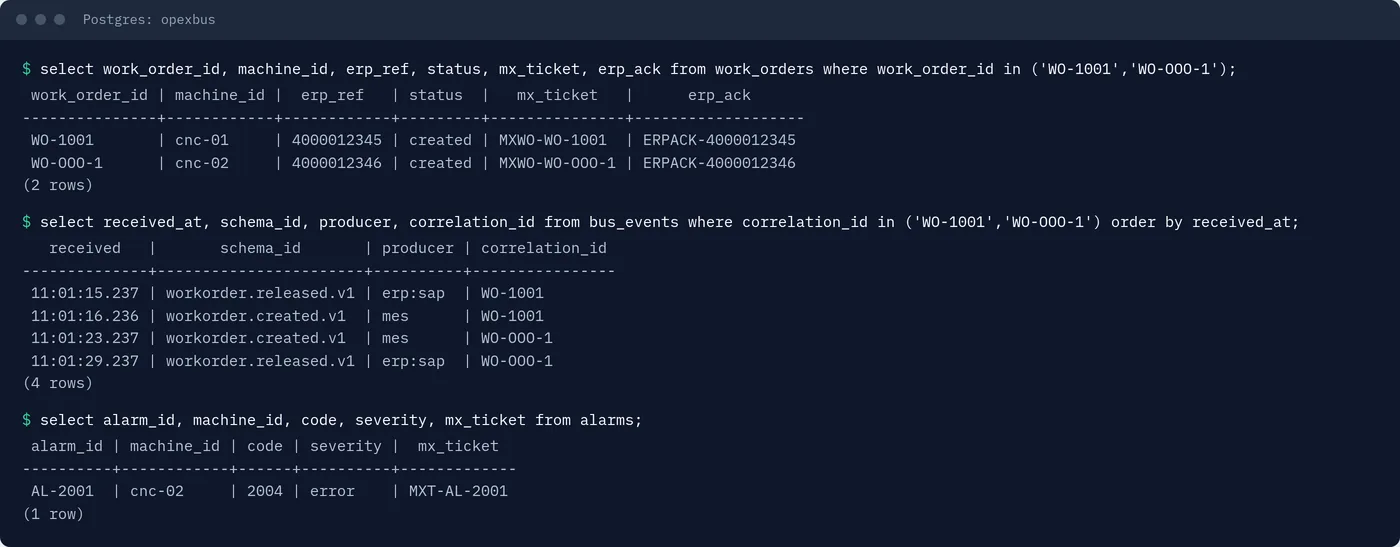
Two work orders were taken through the system: WO-1001 in the normal order and WO-OOO-1 in the reverse order. The first query returns both with their ERP reference, OpexMX ticket and ERP acknowledgement. The second lists their events in the order they arrived, whichever system produced them. The third is the alarm and its ticket.
Scope
- Tested against Postgres 16 with plain tables. The TimescaleDB image of the repository compose file was not used, because these tables hold events, not telemetry.
- The producers and the OpexMX and ERP endpoints are simulated. The messages were checked against the opex-contracts schemas before they were published.
- The statements shown are the ones that ran. Table design, indexes, retention of bus_events and the status model of a work order are set per installation.
- The ERP status call can go twice if the release and the created event are processed at the same moment. The status call is idempotent in the stand-in service.
- A sql or transform node that adds a top-level field to the record makes a later filter or branch node refuse it. The flows therefore keep their filters before the first SQL step and stop a record with a transform that returns nothing.